
When transporting goods by truck, trailer, rail, or container, keeping cargo securely in place is just as important as delivering it on time. Unsecured loads can shift during braking, cornering, or sudden acceleration, leading to damaged goods, vehicle instability, and safety risks.
This is where ratchet lashing plays an essential role.
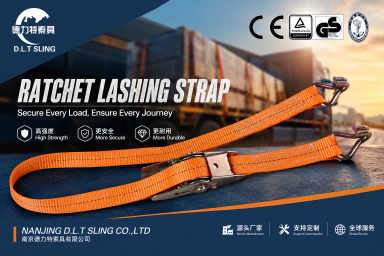
A ratchet lashing system uses high-strength polyester webbing, a ratchet tensioning mechanism, and end fittings to secure cargo during transportation. It is widely used across logistics, construction, manufacturing, agriculture, and marine industries because it provides a reliable, reusable, and cost-effective method of cargo securing.
Whether you are purchasing your first ratchet lashing straps or looking for a dependable supplier, understanding the basics will help you choose the right solution for your transportation needs.
A ratchet lashing is a load restraint device designed to prevent cargo from moving during transport.
Unlike traditional ropes, which rely on knots and manual tension, a ratchet lashing system uses a mechanical ratchet buckle that allows the operator to tighten the webbing quickly while maintaining consistent tension throughout the journey.
Most ratchet lashing systems include three essential components:
Together, these components create a secure load restraint system suitable for transporting a wide range of cargo.
The webbing is manufactured from high-tenacity polyester yarn, offering excellent strength while remaining lightweight and flexible.
Compared with steel chains, polyester webbing is easier to handle and is less likely to damage painted or delicate cargo surfaces.
Key advantages include:
The ratchet buckle is responsible for applying and maintaining the required tension.
Its locking mechanism prevents accidental loosening during transportation while allowing quick release when unloading.
A high-quality ratchet buckle should feature:
Different transportation equipment requires different hook styles.
Common end fittings include:
Selecting the correct end fitting helps ensure that the strap remains securely attached throughout transportation.
Using a ratchet lashing strap is straightforward:
Step 1: Position the cargo correctly on the vehicle.
Step 2: Attach both ends of the strap to approved anchor points.
Step 3: Feed the loose webbing through the ratchet spindle.
Step 4: Operate the ratchet handle until the required tension is achieved.
Step 5: Lock the ratchet and secure any remaining loose webbing.
Once properly tensioned, the strap applies continuous pressure that minimizes cargo movement caused by vibration, braking, or cornering.
Ratchet lashing systems are suitable for securing many different types of cargo, including:
Because of their versatility, ratchet tie down straps have become one of the most commonly used cargo restraint products worldwide.
Although ropes are still used for some light-duty applications, ratchet lashing provides several important advantages.
| Ratchet Lashing | Traditional Rope |
|---|---|
| Consistent tension | Manual tightening |
| High load capacity | Limited strength |
| Fast installation | Time-consuming |
| Reusable | Knots loosen easily |
| Professional cargo securing | Suitable only for light loads |
For commercial transportation, ratchet lashing offers greater safety, efficiency, and reliability.
One of the most important specifications when selecting a ratchet lashing strap is its Lashing Capacity (LC).
LC indicates the maximum force that the lashing system is designed to withstand during normal use.
Many buyers mistakenly focus only on the width of the webbing. However, two straps with the same width may have different LC ratings depending on the webbing construction and hardware.
Always choose a ratchet lashing strap according to:
Before purchasing, consider the following factors.
Common widths include:
Choose a length that allows the strap to wrap around the cargo while leaving enough webbing for proper ratchet operation.
Select end fittings that match your vehicle's anchor points and cargo securing system.
Always verify that the LC meets your transportation requirements.
High-quality ratchet lashing straps are typically produced according to EN 12195-2, ensuring reliable performance and consistent quality.
Regular inspection is essential for transportation safety.
Before using a ratchet lashing strap, check for:
Any damaged strap should be removed from service immediately.
Yes. Ratchet lashing straps are designed for repeated use when they are properly inspected and maintained. Replace any strap showing signs of damage or excessive wear.
Polyester webbing absorbs very little moisture and performs well in wet environments. However, straps should always be cleaned and dried before long-term storage.
Lashing Capacity (LC) is the maximum working force used for cargo securing.
Breaking Strength is the force at which the product may fail during laboratory testing. Products should always be selected according to the LC value rather than the breaking strength.
Yes. Many manufacturers provide OEM services, including:
Choosing the right supplier is just as important as choosing the right product.
At NANJING D.L.T SLING, LTD, we manufacture high-quality polyester ratchet lashing straps for customers worldwide. We offer a wide range of webbing widths, lashing capacities, hook options, and OEM customization services to meet different transportation requirements.
Our products are manufactured under a strict quality management system and can be supplied with CE, GS, and ISO 9001 certification, along with factory testing reports upon request.
If you are looking for a reliable cargo securing solution or would like to discuss your OEM project, our team is ready to provide professional support and competitive quotations.





 IPv6 Network Supported
 Email : sales@dlt-sling.com
 Get A Quote